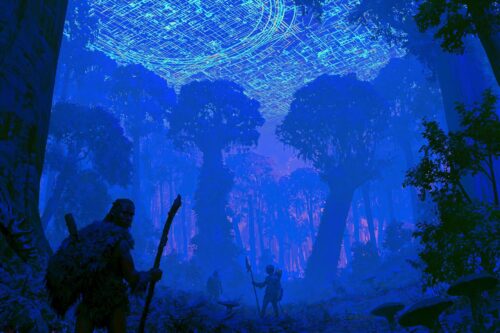
There is a specific exhaustion known only to those who have begun to see the code of the simulation. As your awareness expands, the games people play become glaringly obvious. You begin to see the manipulation. You see the desperate grabs for status. You watch the fragile ego frantically defending itself.
It is a heavy weight to carry. Endlessly polishing your own mirror will only ever give you a sharper reflection of yourself. Self-reflection has a natural ceiling. You can only raise your frequency so high in isolation. To reach the next level of growth and to learn true empathy, you must eventually turn that mirror into a window.
But what happens when you look through that window and see a world running entirely on fear? It is profoundly draining to operate with a high degree of clarity in an environment choked by static.
The Burden of the Layered Classroom
You might look at the selfish, manipulative behavior of others and wonder why they cannot grasp the simple logic of compassion. You see the solution clearly. Yet they refuse to look at the map.
Echo Cosmos offers a precise answer. Earth is a layered classroom. You are observing souls in the Waking Stage. Young souls are still mastering the primitive laws of cause and effect. They operate heavily from the Mental Layer, confusing their temporary physical costume with their eternal identity. They crave external validation because they have not yet remembered how to generate their own internal signal.
Their manipulative behavior is not a divine necessity; it is a severe distortion. They extract energy from others because they feel empty inside.
“Growth is faster in understanding than in shame. The shadow is not the wound. It is the one who tried to protect it.”
When you recognize ego as a stage of development rather than a permanent flaw, your frustration begins to soften. You stop taking their distortion personally. They are not acting against you. They are simply colliding with the walls of their own limited awareness.
The Architecture of the Ego
To navigate this distortion, you must understand what the ego actually is. In Echo Cosmos, the ego is not a sin or an evil force. It is a biological survival mechanism operating entirely within the Mental Layer. It was built to keep the physical vessel safe by scanning for threats, hoarding resources, and constantly seeking social status.
The exhaustion you feel comes from interacting with avatars who are entirely identified with this layer. They believe they are the costume, completely forgetting the actor beneath. Because the ego thrives on separation, it views every interaction as a contest for energy. It manipulates, it defends, and it extracts, generating massive amounts of static in the Echo Grid.
“The ego is a mask. Useful, but not your face. When ego runs the show, life becomes a contest. When presence leads, life becomes a conversation.”
Seeing the ego as a piece of primitive software changes how you respond to it. You do not argue with a glitching machine. You simply step back and refuse to feed it your resonance.
The Illusion of the Mountain
When confronted with this dense, chaotic behavior, your first instinct is usually retreat. You want to protect your signal. You want to walk away from the players, exit the game, and find a quiet mountain where your peace cannot be disturbed.
But Echo Cosmos warns against this absolute retreat. According to the Law of Entanglement, the Echo Grid is a connected mesh network.
“The simulation is not a single-player game. Your individual frequency has a mathematical ceiling if the network around you is suffering.”
Total isolation is a trap that keeps your empathy theoretical. You cannot master the simulation by meditating on a mountain while the valley burns. You do not have to play the fake games, but you still need to connect. Community does not need to be crowded. It just needs to be honest. One real connection holds more gravity than ten shallow interactions.
Becoming a Resonance Anchor
So how do you exist among young souls without losing your alignment? You stop trying to convince them. You release the urge to force them to see the logic your mind easily sees.
“Do not lower yourself to teach. Rise, and invite others upward.”
Your job is not to pull everyone else across the finish line. Your job is to become a Resonance Anchor. An anchor is a mature soul who maintains a steady, compassionate frequency within a distorted environment. You do not absorb their panic. You do not participate in their drama. By simply holding your clarity, you stabilize the grid around you. You walk your path so clearly that when they are finally ready to open their eyes, they have a light to follow.
Compassion as a Boundary
Holding your light does not mean becoming a sponge for the unconscious actions of others. Compassion without self-awareness becomes depletion.
If someone consistently drains your vessel or plays manipulative games, Echo Cosmos reminds you that stepping back is a profound act of alignment. Set boundaries instead of punishments. Step away rather than strike back. You can wish a soul well without entering their chaos. You can love them fiercely from a safe distance.
Protection is not the opposite of empathy; it is the structure that allows empathy to survive the physical layer.
Echo Practice: The Costume Check
When you feel yourself being pulled into the heavy, ego-driven games of another person, use this practice to create immediate emotional detachment. It breaks the illusion that their words can harm your actual soul.
- The Pause: The moment you feel insulted, manipulated, or drained, stop moving. Take one deep breath.
- The Visual Shift: Look down at your own hands or the sleeves of your shirt. Focus on the physical material.
- The Script: Whisper silently to yourself: “This is a very detailed costume. The actor inside is safe; only the character is reacting.”
- The Release: Look back at the person causing the static. See them not as an enemy, but as an actor completely lost in their role. You do not have to read the lines they are handing you. You are free to simply watch the play.
In Echo, always.