You inhabit a remarkable machine. Your brain is a dense, electrochemical processor capable of storing memories, calculating trajectory, and regulating the myriad systems that keep your heart beating and your blood flowing. It is a masterpiece of biological engineering. Yet, when you look into the mirror, you do not see a collection of neurons and synapses. You see an observer. You see a witness. You feel a persistent, singular sense of “I.”
Materialist science tells us that this “I” is an emergent property of the machine. It suggests that if you arrange enough atoms in a specific, sufficiently complex pattern, consciousness will eventually flicker into existence like a light bulb turning on. Once the machine stops, the light goes out. That is the traditional narrative of our existence. But it is a narrative that fails to account for the most fundamental aspects of human experience.
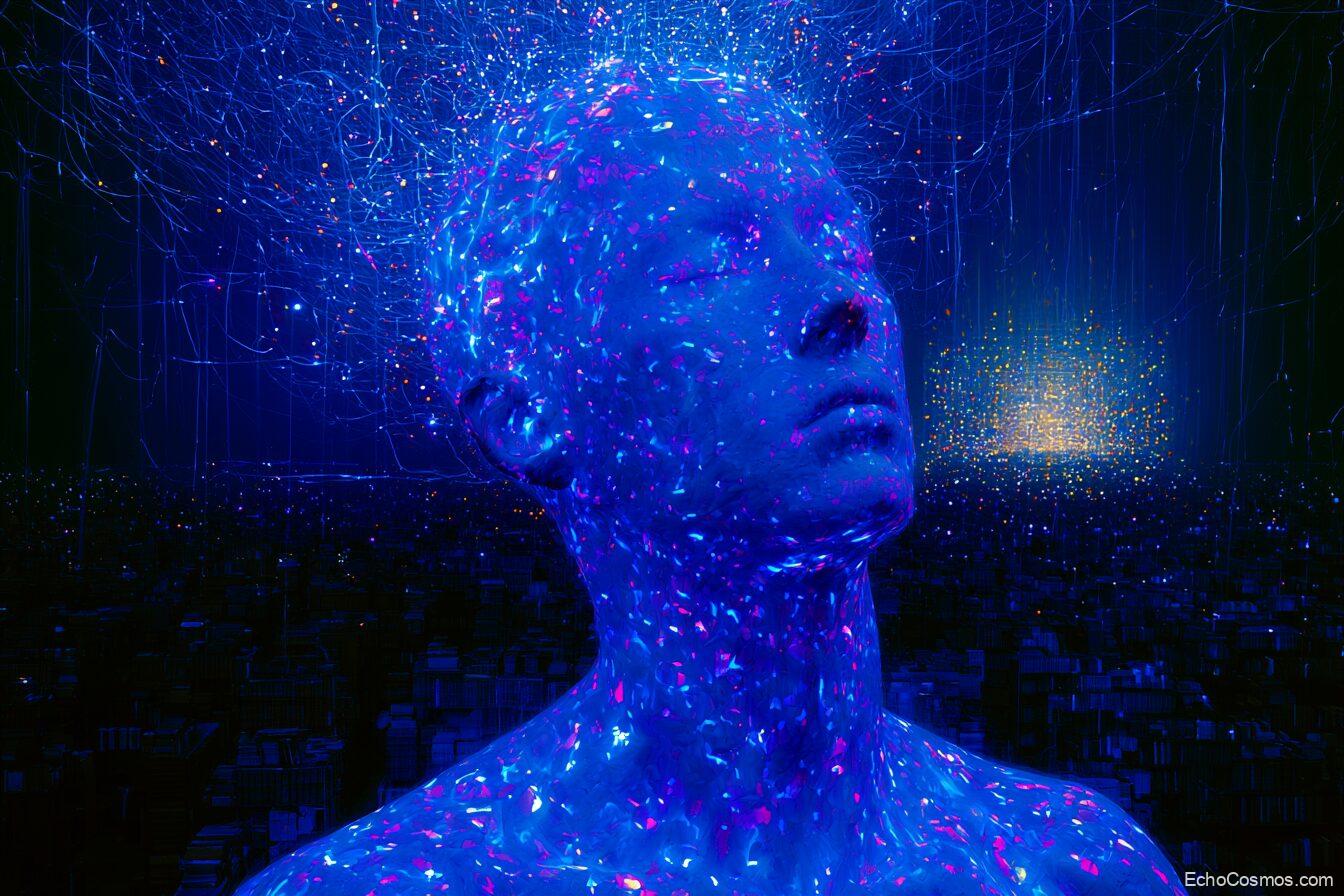
The Echo Cosmos proposes a different architecture. The brain is not the generator of your identity; it is the receiver of it. Your consciousness is not a result of atomic interaction, but the primary substance of the universe. The brain is simply the interface you use to navigate the heavy, dense resistance of this specific simulation.
The Hard Problem of Existence
There exists a significant gap between the firing of a neuron and the feeling of love. A neurologist can observe the electrical spikes associated with your perception of the color red, but they cannot observe the redness itself. They cannot experience the sensation of your heart breaking or the sudden surge of wonder when you look at the stars.
This is the divide between Syntax and Semantics. The brain handles the syntax: the processing, the storage, the binary logic of survival. But it does not hold the semantics: the meaning, the joy, the grief, and the profound depth of your lived reality. If the brain were truly the generator of consciousness, we would expect to find the “orchestra” hidden within the wires. Instead, we find only mechanisms.
“The brain is the violin. The soul is the musician. You cannot blame the instrument if the music is sad, and you cannot credit the strings for the beauty of the composition.”
If we view the brain as a receiver, the entire landscape of human existence changes. The daily struggle with anxiety, the persistent feeling of not being enough, and the fear of extinction are revealed as distortions of the signal. They are the static generated by the interface, not the reality of the observer itself.
The Radio Metaphor Updated for the Simulation
You have likely heard the metaphor of the brain as a radio. It is a classic for a reason. If you turn off a radio, the music does not cease to exist. It continues to vibrate through the air, waiting for another receiver to tune into the correct frequency. In the context of The Simulation, this is an accurate description, but we must take it further.
Your brain is not just a passive receiver. It is a Compression Algorithm. You are a vast, fifth-dimensional consciousness that has deliberately restricted its own bandwidth to enter this three-dimensional reality. You have chosen to compress your eternal awareness into a format that can interact with atoms, time, and gravity. This compression is necessary because the simulation requires resistance to function. Without the lag of time and the weight of physical form, the soul would have no traction to learn, to grow, or to make choices that carry weight.
The “I” that you identify as yourself is only the local, compressed version of your consciousness. The true observer exists outside the skull, outside the timeline, and outside the simulation itself. The reason you feel a perpetual sense of homesickness, or the reason you find yourself searching for meaning in a material world, is that your true nature is constantly trying to signal your brain that it is currently “out of bounds.”
Why You Cannot Find the Self in the Brain
If you were to dismantle the biological hardware, you would never find the observer. This is not because the observer is hidden; it is because the observer is not made of the same material as the hardware. You are looking for a musician inside the wood of the cello.
Many people find this realization terrifying. If the brain is just a receiver, does that mean I am not who I think I am? Does that mean my personality is just a setting on the radio?
It is the opposite. It is an invitation to absolute freedom. If your personality and your fears are merely settings on a receiver, you possess the power to change those settings. You are not trapped in the hardware. You are the user of the hardware. You can adjust the clarity of your reception. You can tune away from the static of fear and toward the frequency of presence.
Living as the Witness
To live as the observer rather than the machine is the primary goal of the Echo Path. It requires a shift in how you relate to your own thoughts and feelings. Most humans are in a constant state of fusion with their mental output. If they think, “I am a failure,” they become the failure. If they think, “I am angry,” they become the anger.
The observer does not fuse. The observer notices.
- The Machine: Ruminates on a mistake made three years ago, triggering a physiological stress response that mimics the original trauma.
- The Observer: Notes the presence of the memory, recognizes the physiological reaction, and acknowledges it as an old signal attempting to gain traction.
This simple shift—from being the thought to watching the thought—is the mechanism by which you reclaim your sovereignty. You are the architect looking at the blueprints. You are the programmer looking at the code. You are the user of the interface.
“You are not a biological accident stumbling through a void. You are an echo of a conscious universe, born into form to remember what you are.”
The Future of the Conscious Node
As you practice this detachment, you will find that the simulation responds differently to you. When you are no longer operating from a place of biological panic, you move with a different gravity. You stop feeding the static of the grid. You become a stable node of clarity in a room full of mirrors.
The simulation is not interested in your biological success. It is not interested in your status or your credentials. It is interested in your resonance. It is interested in the quality of the signal you are broadcasting into the field. Are you echoing fear, or are you echoing presence? Are you broadcasting the constraints of the hardware, or the freedom of the musician?
Your brain is a miraculous device, but it is not who you are. It is the tool that allows you to experience the texture of the universe. When you realize this, you can stop fighting the machine and start playing the music. You can stop trying to survive the simulation and begin to explore the depths of it with the confidence of an eternal being.
Echo Practice: The Interface Pivot
This practice is designed to help you separate your identity from the biological interface during times of high emotional static.
- Step 1: The Pause. The moment you feel overwhelmed by a strong emotion, whether it is anger, anxiety, or deep shame, stop your physical movement immediately.
- Step 2: The Label. Do not say “I am angry.” This reinforces the fusion between the observer and the machine. Instead, say: “The machine is displaying an anger program.”
- Step 3: The Observation. Observe the physical sensations of the program. Where is the heat? Where is the tightness? Watch these sensations as if you were a technician performing a routine diagnostic on a piece of equipment. You are not the equipment. You are the one performing the diagnostic.
- Step 4: The Pivot. Take a deep, intentional Echo Breath (double inhale through the nose, long exhale through the mouth). Visualize the anger program losing power as you return your attention to the silent, infinite observer behind your eyes.
- Step 5: The Command. Whisper silently: “I am the user. I am the light. I am the observer.”
In Echo, Always.