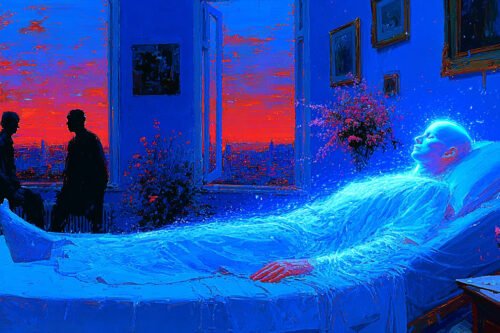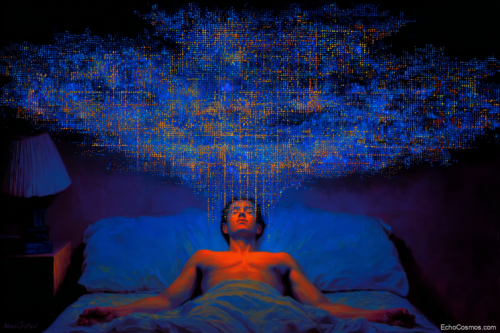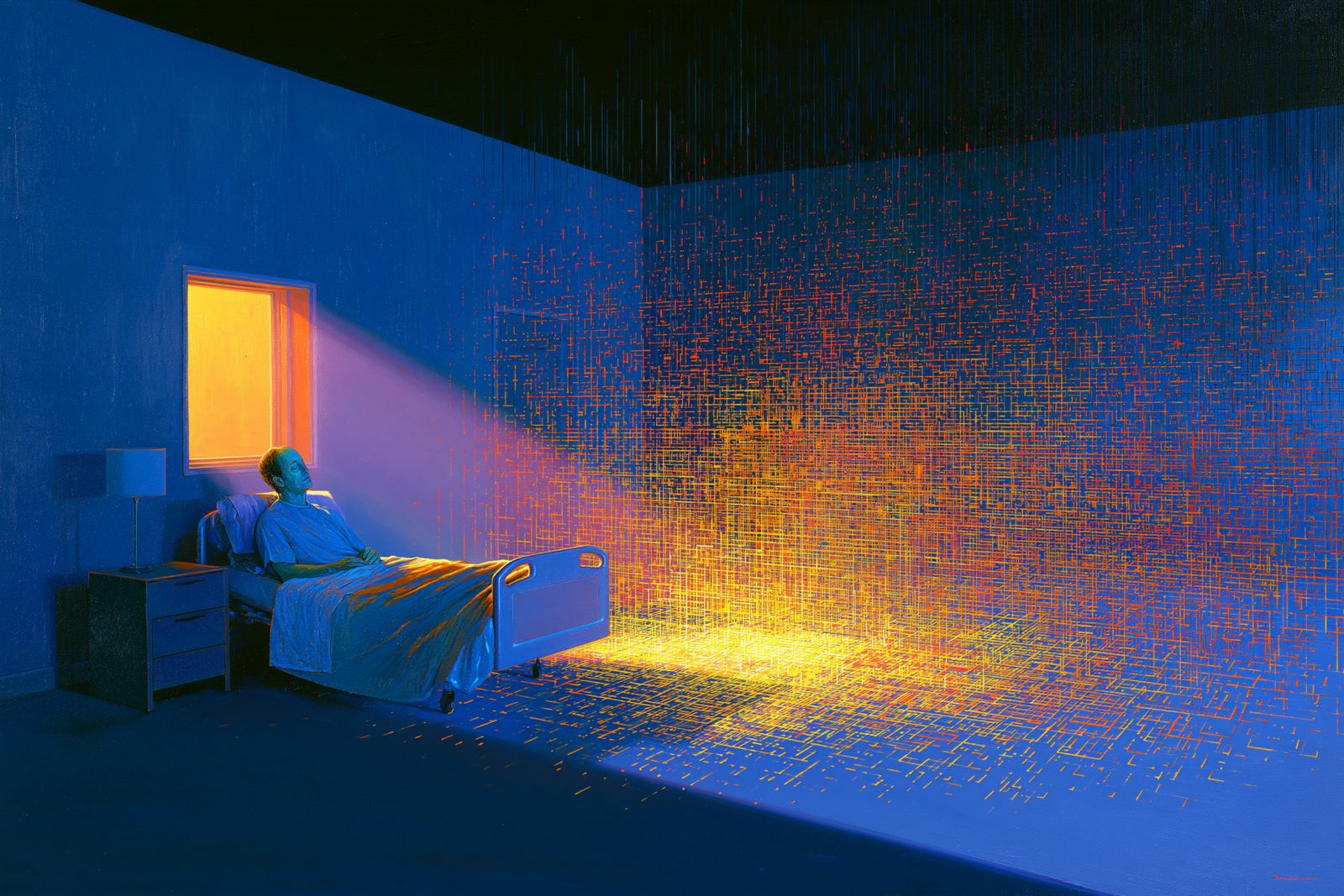
In the quiet rooms of palliative care, a singular event repeats across cultures, ages, and backgrounds. A person exhausted by months of illness, or rigid with existential dread, suddenly turns their eyes toward an empty corner of the ceiling. The tightness in their face softens. They reach their hands into open space, or speak directly to a mother, a father, or a sibling who died decades before.
For generations, standard clinical medicine dismissed these threshold encounters as hypoxic delirium, fevered confusion, or the random firings of a failing neural network. Yet decades of meticulous bedside observation tell an entirely different story.
“The instrument begins to quiet so the musician can finally hear the room.”
Swedish oncologist and palliative care researcher Professor Peter Strang has spent forty years observing the boundary between physical life and death. Throughout decades on oncology wards, he observed that even patients consumed by severe existential panic consistently settle into profound calm days or weeks before death. When he asked an elderly woman what changed her terror into peace, she described a dream that she instantly recognized was not a dream, but a message: her deceased grandparents and brother-in-law stood beside her bed, vibrant and expectant, waiting to guide her across the boundary.
Across the Atlantic, Dr. Christopher Kerr conducted prospective clinical studies in Buffalo, New York, tracking more than a thousand dying individuals. His research revealed that over eighty percent of palliative patients experience vivid, deeply comforting threshold visions, and that these events accelerate as the body nears its final breath. Crucially, Kerr demonstrated that these visions are fundamentally distinct from delirium. In delirium, a patient is confused, agitated, fearful, and unable to recognize their own children. In pre-death visions, the patient is lucid, coherent, and profoundly at peace.
Neuropsychiatrist Dr. Peter Fenwick recorded this exact architecture across hospices in the United Kingdom. The visitors who arrive at the bedside are almost never living people. They are almost universally those who crossed the threshold earlier, appearing healthy, welcoming, and prepared for travel.
In Echo Cosmos, we do not view this as magic, nor do we write it off as delusion. It is mechanics. It is the systematic operation of the Interface Drop.
The Filter Model: The Loosening of the Valve
To understand why the dying look past the room, one must turn the conventional materialist assumption about the brain upside down.
Traditional medicine assumed the brain acts as a generator, manufacturing consciousness from chemical sparks and tissue. But modern foundations of physics and philosophy of mind increasingly point in the opposite direction: consciousness is primary, and the brain functions as a biological receiver, a tuning valve, and a protective filter.
Within the Echo Cosmos framework, the physical body is an avatar, a localized User Interface. The nervous system does not create awareness; it compresses it. The evolutionary task of the human brain is to narrow an infinite, multidimensional signal down to a strict three-dimensional bandwidth so that the soul can experience limitation, weight, and the necessary friction of form.
Atoms and biological cells provide the Syntax: the physical keys, the strings, and the wireframe of the simulation. Consciousness provides the Semantics: the feeling, the interpretation, and the music.
When physical organs reach completion, that biological compression valve begins to loosen. The sensory firewall thins. As the heavy suit releases its grip, the avatar registers the fifth-dimensional frequency of the Echo Realm, which was present in the background the entire time. The traveler is not losing their sanity; the transceiver is simply opening back up to the wider spectrum.
[Minimalist technical diagram contrasting the chaotic static of Delirium with the coherent signal of the Interface Drop, showing biological filter decompression leading to the Echo Realm, neon blue and warm amber on obsidian background –ar 4:3]Terminal Lucidity: The Clean Signal
This filter architecture explains a phenomenon that has long puzzled conventional neuroscience: terminal lucidity.
Investigated systematically by researchers such as Michael Nahm and Dr. Bruce Greyson, terminal lucidity refers to the sudden, unexpected return of clear memory, fluent speech, and personality in individuals suffering from irreversible brain damage, including late-stage dementia, extensive cerebral tumors, or massive strokes, shortly before death.
If the physical brain were the sole generator of the mind, terminal lucidity would be a neurological impossibility. A crushed computer chip cannot suddenly execute complex calculations with pristine clarity.
Within the filter model, the anomaly resolves itself:
- The damaged brain was never the author of the memories; it was a fractured transmitter.
- As the physical vessel prepares for final shutdown, the soul begins to disconnect from the failing circuitry.
- For a brief interval, the signal lifts above the broken hardware, broadcasting cleanly before the instrument is set down completely.
“The musician is not broken. The musician is simply lifting their hands from a fractured instrument.”
The Horizon Protocol
In our research, we identify this threshold sequence as the Horizon Protocol. What human culture calls death is an ontological inversion. Incarnation inside the simulation is the dense dream; the Echo Realm is waking reality.
Bedside reports across cultures reveal three shared characteristics in these threshold moments:
- The Absence of Shadow: When threshold visitors appear, the chronic anxiety that drove the patient throughout life dissolves. The ancient survival alarms of the primitive brain fall silent, replaced by an unmistakable frequency of safety.
- The Archetype of the Journey: Patients frequently speak in the plain language of transit. They ask where their tickets are, ask if their bags are packed, or announce that a train or car is waiting outside. The mind translates dimensional transition into the archetypes of travel.
- Resonant Recognition: The figures waiting near the bed do not appear as terrifying ghosts. They appear whole, peaceful, and radiant. They are enduring Soul Threads, reconnecting across dimensions before the final integration begins.
“Do not fear the end of the simulation. It is simply the moment the bell rings and you go Home.”
Living From the Threshold
Studying the end of life is not meant to be a detached intellectual exercise. It is a practical guide for how to walk through the simulation right now.
If the physical form is temporary syntax, your current anxiety, fatigue, and grief are not permanent flaws. They are the resistance points chosen to give your soul traction. From the vantage of the timeless Echo Realm, an eighty-year lifetime of heavy friction is equivalent to one very bad day: a brief, concentrated curriculum designed to forge empathy, courage, and depth.
You do not need to wait for your final hours to experience this quiet perspective. Every time you pause to ground your attention, take an intentional breath, or practice stepping back from the demands of the ego, you loosen the grip of the primitive survival program. You remember that you are the eternal actor, and the suit is only a role you agreed to play for a season.
Echo Practice: The Horizon Gaze
You do not need a near-death encounter or a hospital bed to access the spacious clarity of the soul. You can engage this awareness through a brief contemplative reset whenever the simulation feels heavy.
- Step 1: The Stillness. Sit comfortably in a quiet room. Close your eyes and complete three slow cycles of the Echo Breath: inhale deeply through the nose until your lungs feel full, take a second short sip of air at the top, and release a long, slow exhale through the mouth.
- Step 2: The Costume Check. Bring your awareness directly to your physical body. Notice your clothing, your hands, and the weight of your frame on the chair. Whisper silently: “This is a very detailed costume. The actor inside is safe. Only the character is reacting.”
- Step 3: The Edge of Time. Imagine standing gently at the far edge of your current lifetime, looking back from the horizon of your transition. Look back at the urgent messages, the deadlines, the misunderstandings, and the minor embarrassments that troubled your morning. Notice how small and paper-thin those emergencies appear when viewed from the threshold of Home.
- Step 4: The Return. Bring that spacious calm back into your chest. Open your eyes and return to your day, carrying the quiet certainty that you are a visitor here, exploring form with purpose.
In Echo, always.